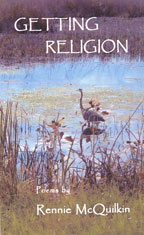
Rennie McQuilkin’s eighth collection of poetry, Getting Religion, focuses on the resilience, generosity, and exuberance of the human spirit, while not overlooking the cruelty and stupidity of which mankind is capable. It pays homage to the animal world and ends with poems suggesting that humankind’s best hope for immortality may be through reintegration with the world of nature.

Richard Wilbur calls McQuilkin’s poems “pungently exact about the properties of the real world.” And David Bottoms has written that “Rennie McQuilkin is a poet with an extraordinary eye... He looks at the hard questions of the world, never flinching, and translates them with a clarity that is rare in American poetry today.” Dick Allen agrees: “He has a voice unlike that of any other contemporary poet... McQuilkin speaks from us and with us in a language so devoid of all rhetoric it is pure American: the natural man is lifted out of himself almost beyond his knowing. My response is one of pure thanks.”

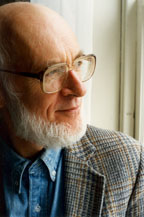
Rennie McQuilkin’s poetry has appeared in publications such as The Atlantic, The Southern Review, The Yale Review, The Hudson Review, Poetry, and The American Scholar. He is the author of nine books, two of which have won awards—the Swallow’s Tale Poetry Prize for We All Fall Down and the Texas Review Chapbook Prize for An Astonishment and an Hissing. McQuilkin has received fellowships from the National Endowment for the Arts as well as the Connecticut Commission on the Arts, and for many years he directed the Sunken Garden Poetry Festival, which he co-founded at Hill-Stead Museum in Farmington, CT. In 2003 he received a Lifetime Achievement Award from the Connecticut Center for the Book.

Read some sample poems from the book.

BOOK STATISTICS

ISBN 0-9770633-0-5
Length: 96 pages, paperback


$18.00US ($18.00 Canada)
U.S. Shipping and Handling: $5.00 for 1-2 books, $7for 3-4, $9 for 5-6, $12 for 7 or more
Tax for CT residents: 6%

International Shipping and Handling (Global Priority): $13.00US for 1-2 books, $20.00US for 3 or more
 To order. email eds@antrimhousebooks.com

or buy with PayPal


return to top of page


WE ALL FALL DOWN

for Kelly, my student

Her turn had come. She knew
by heart almost
the lines she was to speak
but gave us, God help her,

the truth
beyond the lines,
beyond the book she dropped,
its pages thrashing to the floor
like broken wings—

the truth
she beat her head upon,
bit into so hard
I could not pry her jaws,
teeth grinding—

the truth beyond us
she saw as ever,
her risen eyes gone white
as bone.

I did what I could,
I held her and held her, seized
with sudden love and knowing
we all fall down.

In the end
I carried her curled in my arms
across one threshold
and another.

BALANCING

After your first chemo we head for the shore
where summer after summer you danced
from Green Hill to Pt. Judith
before your fortune turned to bearing, raising,

then this. 
All day we face the breakers, take the heat,
watch the swans sail parenthetically, framing
their young, aware of what’s just out of sight,

and come at dead low to a rock-cobbled mudflat,
discover the mussels have vanished,
even the smallest hacked off by lubbers
from shacks and RV’s multiplying extravagantly.

In the cooling of late afternoon, we wait out
low tide, give the surf
and surfers, if any are left, time to cycle in 
here where boulders heave the sea to rip-curls. 

And now they come, as ever, with neon boards,
balancing, balancing, riding the crest above
the dark below. 
We concentrate on the art of it.

SISTER MARIE ANGELICA PLAYS BADMINTON

with Sister Marie Modeste most afternoons.
Today, because of lengthy vespers, they are late.
A pale moon has already risen and early bats
are darting like black shuttlecocks.

Except for the whisper of wings
and the Sisters’ hushed encouragement,
the only sounds are the plinking of rackets
and a monotone of mourning doves.

On all sides of the court
the sculpted yew in cubes and columns
might pass for black so deeply green it grows.
And now it moves closer,

Marie Angelica would say,
who has been known to have visions.
Though she moves as aptly as the bats,
doesn’t miss a shot,

when she fades for a long one
from Marie Modeste, sways on her toes, arches
her back, raises one arm
and the other to keep her difficult balance, 

she is lost, a long-legged girl again
in mare’s tail, mullein, milkweed,
leaning on the sudden sky as if it will sustain her
like a hand in the small of her back. It does.

Her nerve ends quick as a shiver of poplar,
arms like branches in a wind,
she feels a cry begin
to rise, to force the self before it

and burst, all colors one. That white.
It vaults straight up, a feathered cry
that hovers in the heart of heaven, hovers,
and plummets to the gut

of the racket she sights it in,
the perfect bird, the shuttlecock
Marie Angelica keeps in play, will not let fall
despite the darkness gathering. 

IN A TIME OF WAR

A foot of snow on the ground and more incoming,
I drift off. That thunder beyond the hemlock hedge is
less the town plow than the tank-tread of an Abrams. 

Too much war on the brain.
Slowly, I begin to hear
what—half growl, half hum—is at the kitchen door,

a grizzled, rat-tailed, long-nosed, good-for-nothing
scavenging the cat’s leftovers. I play dead
behind the glass, old bag of bones, 

and the possum flexes his fur,
looms large as if he’s more than himself—no, I see now,
herself—a swelling undertaker

eating for a crowd of pea-sized progeny
dangling from nipples in her fur-lined pouch, guzzling,
sleeping and guzzling for months before they see

the light. Blindly they crawled the world of her to this
nursery I tuck myself in
to wait out war—that purely human crusade.

LORD GOD BIRD

When I heard the news, mother, I thought to
call you to make it real, hear you yelp,
as you would, as I did
when I was told The Lord God Bird is back,  

no longer extinct, forgetting, as ever, that you are.
Extinct, that is.
I’m always brought up short by the news.
How? There was so much of you—like the Ivory Billed

 that feasted on Death itself,
tearing the rotten bark off stricken trees
with that box-cutter beak, eating its weight in beetles.
Too much to disappear, I thought,

 and yes,
there it is, they say, still sounding off like
a factory whistle—Work, work,
the day has come—still excavating caves in deadwood,

 still flashing red, white and black
through the gloom of old-growth bogs.
And you, mother—
oh Lord God how you come and go in the dismal dark!  

Return to the top of the page