|
|


|
|
|
McQuilkin was for many years the director of the Sunken Garden Poetry Festival and has received grants from the National Endowment for the Arts and the Connecticut Commission on the Arts. His work has appeared in The Atlantic, Poetry, The Yale Review, Yankee, The Hudson Review, The Southern Review, Crazyhorse, The Gettysburg Review, The Christian Science Monitor, The North American Review, The American Scholar, and many other publications. Read some poems from the book. Praise for the book: "Rennie McQuilkin's poems are pungently exact about the properties of the real world: how things look, what they're called, how they happen. In a book which has poignancy, gusto, and many another mood, there is never a false feeling... Most of all I relish in these poems the surprising yet probable way in which a scene or association of images can produce what seems an inevitable development of thought." - Richard Wilbur
"He has a voice unlike that of any other contemporary poet - so natural, so sympathetic, so convincing that the many moments and passages of fulfilled perceptions occur in these poems like the effortless unfolding of wings. McQuilkin speaks from us and with us in a language so devoid of all rhetoric it is pure American: the natural man is lifted out of himself almost beyond his knowing... My response is one of pure thanks." - Dick Allen |
|
BOOK STATISTICS ISBN: 0-9662783-4-8
|

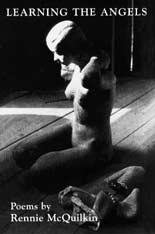 Learning
the Angels is Rennie McQuilkin's fifth book of poetry.
Learning
the Angels is Rennie McQuilkin's fifth book of poetry. "Rennie
McQuilkin is a poet with an extraordinary eye. But more than that, he is a
poet who knows how to use it. He looks at the hard questions of the world,
never flinching, and translates them with a clarity that is rare in American
poetry today. Whether he is writing about the world itself, or the world
mirrored in art, his poems strike to the heart of the thing and give us time
and again 'the truth beyond the lines.' " - David Bottoms
"Rennie
McQuilkin is a poet with an extraordinary eye. But more than that, he is a
poet who knows how to use it. He looks at the hard questions of the world,
never flinching, and translates them with a clarity that is rare in American
poetry today. Whether he is writing about the world itself, or the world
mirrored in art, his poems strike to the heart of the thing and give us time
and again 'the truth beyond the lines.' " - David Bottoms|
LEARNING THE ANGELS
Waiting up, he’s deep in Angels & Archangels: lion-bodied Cherubim, Principalities six-winged, translucent as cathedral windows, heavily armored Archangels, and the usual angels for the dirty work, recording, hand- delivering, and as he now learns, placing a finger on the lips of every newborn, leaving the cleft imposing silence concerning clouds of glory. Now she breezes in, douses the light, wants to cuddle, undoes, runs a finger along the cleft that gives the tip of his sex its face of a heart. It's devil's work, he knows. At dawn he’s in the dew-damp garden, picking strawberries for her, turning the leaves pale-side-up to uncover the heart-shaped fruit, and coming on the snake, a hog nose, head up, neck flared and glistening.He knows its lineage, says
his prayer to angels, archangels and wheels of fire. Reinforced, he returns full of Powers and Dominions. She yawns, half-rises on her divan, plumps a pillow, pours cream on the berries. Its blush deepens. He finds himself sliding a hand beneath her robe, along the nape, the shoulders, the spine, the small, that valley lightly downed— which leads to what comes over him, her shoulder blades working the air, her
finger on his lips. WE ALL FALL DOWN for Kelly, my student Her turn had come. She knew by heart almost the lines she was to speak but gave us, God help her, the truth beyond the lines, beyond the book she dropped, its pages thrashing to the floor like broken wings-- the truth she beat her head upon, bit into so hard I could not pry her jaws, teeth grinding-- the truth beyond us she saw as ever, her risen eyes gone white as bone. I did what I could, I held her and held her,
seized with sudden love and
knowing we all fall down. In the end I carried her curled in my arms across one threshold and another |
|
THE LIGHTERS for my mother In her eighty-ninth year she’s reducing on one her husband’s initials, full of antique gap-toothed keys with elaborate where every night the dry-bones come
|
|
END OF THE SEASON
Scraping bottom,
I pole us, Whatever's left
now is on its way Is that you humming?
how you let a
slime of duckweed But what do you
make of this and sinks, slowly We know the stories— What you do Next thing, it's
dusk. I like how you
smile, reach back
|
|
|
|
|